
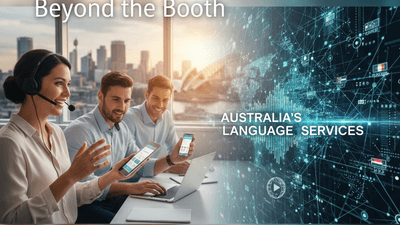



Being a language professional in Australia is no longer just about linguistic conversion; it is about serving as the vital connective tissue in an increasingly diverse society. As the nation's demographics continue to evolve, the translation and interpreting (T&I) industry is experiencing a profound transformation. This shift is being driven by two distinct but complementary forces: the deep, human-centric dedication of individual practitioners and the rapid deployment of on-demand technology in critical public sectors. For language professionals navigating this landscape, understanding the synergy between personal professional development and systemic technological advancements is crucial for long-term career success.
The Human Heart of the Profession: Cassie Lee’s Journey
At the core of the T&I industry are the practitioners who navigate complex cultural nuances daily. The National Accreditation Authority for Translators and Interpreters (NAATI) recently highlighted this human element in their Practitioner Spotlight featuring Cassie Lee, a Certified Interpreter and Translator specializing in Korean and English. Lee's journey offers a compelling look into the realities, challenges, and immense rewards of the profession.
For Lee, the decision to pursue a career in language services was driven by a profound passion for facilitating understanding. Achieving dual certification as both an interpreter and a translator requires rigorous training, an exceptional grasp of colloquialisms and specialized terminology in two languages, and the mental agility to switch between written and spoken modalities. Yet, beyond the technical skills, Lee emphasizes the emotional fulfillment that comes from the work.
"The fulfilling nature of the profession cannot be overstated. We are often the only bridge between a vulnerable individual and the essential services they need to survive and thrive in Australia," Lee notes, reflecting on the intrinsic motivation that sustains language professionals through demanding assignments.
The Power of the Practitioner Community
One of the most salient points from Lee's spotlight is her emphasis on the language professional community. Interpreting, particularly in freelance capacities, can often feel isolating. Professionals are frequently parachuted into high-stakes environments—from courtrooms to emergency wards—expected to perform flawlessly, and then depart without knowing the final outcome of the human dramas they just mediated.
Lee advocates for active participation in professional networks. These communities serve several vital functions for Australian practitioners:
- Peer Debriefing: Providing a safe, confidential space to decompress after emotionally taxing assignments, particularly in healthcare or refugee and asylum seeker contexts.
- Terminology Sharing: Collaborating on the development of standardized glossaries for emerging fields, such as new medical technologies or evolving legal frameworks.
- Mentorship: Connecting seasoned veterans with newly NAATI-credentialed professionals to guide them through the business and ethical realities of freelance work.
Systemic Evolution: SA Health’s 24/7 VOD Initiative
While practitioners like Cassie Lee form the foundation of language access, institutional delivery methods are rapidly modernizing to maximize their reach. A prime example of this is unfolding in South Australia, where the Northern Adelaide Local Health Network (NALHN) is expanding its Video-on-Demand (VOD) Interpreting Services.
This initiative represents a paradigm shift in how culturally diverse communities interact with the healthcare system. NALHN is now providing 24/7 access to qualified interpreters via VOD platforms, a move specifically designed to improve communication, enhance patient privacy, and foster greater independence for individuals who prefer to communicate in a language other than English.
Why Video-on-Demand is a Game Changer
Historically, healthcare interpreting relied heavily on either on-site interpreters (which requires significant lead time and travel) or Over-the-Phone Interpreting (OPI). While OPI is highly accessible, it strips away the non-verbal cues that make up a vast percentage of human communication. In a medical setting, a patient's facial expression, body language, and physical gestures are critical diagnostic indicators.
The NALHN initiative bridges this gap. By utilizing VOD, healthcare providers can access NAATI-certified professionals—perhaps even practitioners like Cassie Lee—at 3:00 AM in an emergency room, complete with the visual context necessary for accurate, empathetic interpreting.
| Modality | Visual Cues | Response Time | Patient Privacy & Independence |
|---|---|---|---|
| On-Site Interpreting | Excellent | Slow (Requires scheduling/travel) | Moderate (Presence of a third party in the room) |
| Over-the-Phone (OPI) | None | Immediate | High (Interpreter is remote) |
| Video-on-Demand (VOD) | High | Immediate | High (Remote, but with visual connection and autonomy) |
For patients, VOD means they do not have to rely on bilingual family members—a practice fraught with ethical and accuracy risks—nor do they have to wait hours for an on-site professional to arrive. It grants them the dignity of immediate, professional communication.
Practical Implications for Australian Language Professionals
The intersection of Lee’s community-focused journey and NALHN’s technological expansion offers several actionable insights for T&I professionals operating in Australia today:
- Optimize Your Remote Setup: As VOD becomes a standard in healthcare and other public services, your home studio setup is now your professional storefront. Invest in high-quality webcams, professional lighting, a neutral background, and, most importantly, a redundant, high-speed internet connection. Your technical reliability is just as important as your linguistic accuracy.
- Master Remote Non-Verbal Communication: Interpreting via video requires a different kind of stamina and presence than on-site work. Practitioners need to practice maintaining "eye contact" with the camera, managing the flow of conversation remotely, and reading the diminished physical cues of patients through a screen.
- Lean Into Community for Resilience: As remote work increases, the natural isolation of the job can deepen. Take Cassie Lee's advice to heart. Join organizations like AUSIT (Australian Institute of Interpreters and Translators), attend NAATI workshops, and actively participate in online forums. Community is your primary defense against burnout.
- Prepare for Shift Work Flexibility: The push for 24/7 access means that language service providers (LSPs) will increasingly look for practitioners willing to work non-traditional hours. This offers incredible flexibility for freelancers who may want to balance interpreting with translating work, study, or family commitments.
Looking Ahead: The Future of the T&I Profession
The Australian language services industry is maturing. The days of interpreting being viewed merely as an ad-hoc administrative task are fading, replaced by a recognition of the profession as a highly specialized, technologically integrated clinical and legal necessity. Initiatives like SA Health's 24/7 VOD service prove that institutional infrastructure is finally catching up to the diverse needs of the Australian public.
However, as technology bridges the geographic divide, it is the passion, empathy, and community-driven excellence of practitioners like Cassie Lee that will ultimately determine the quality of these services. For language professionals, the future belongs to those who can master the digital tools of the trade without ever losing sight of the profoundly human connection at the heart of every translated word.