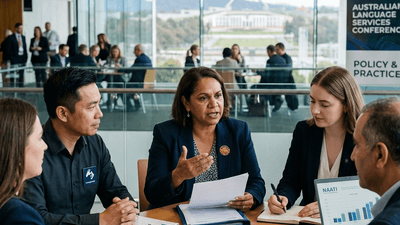
The Australian language services sector has entered a profound paradox in 2026. On one hand, homegrown technological capabilities are expanding at a breathtaking pace, capable of processing hundreds of dialects in milliseconds. On the other, the highly skilled human professionals required to navigate the cultural and ethical nuances of those same languages are threatening to leave the industry in unprecedented numbers. As government agencies and private enterprises navigate this divide, the definition of what it means to be a language professional in Australia is undergoing a radical, and at times painful, evolution.
This week, two seemingly disparate developments have brought this tension to the forefront: a massive expansion by a Sydney-based ...
Trust is the invisible currency of the language services industry. We trade in words, but our underlying product is confidentiality. When that trust is compromised, the market fallout is swift and unforgiving. This month, the Australian language services sector received a stark reminder of this reality following the abrupt collapse of a major industry player's local ...
Language is frequently described as a bridge, but for Australia's culturally and linguistically diverse communities, it is often the very ground they walk on. In an era where industry conversations are dominated by the rapid advancement of artificial intelligence and machine translation, it is easy to lose sight of the profound human infrastructure that underpins our ...
For decades, the archetype of the Australian language professional was firmly rooted in the community sector—facilitating conversations in hospital wards, courtrooms, and government offices. While these foundational pillars remain critical, a quiet evolution is taking place. Today’s translators and interpreters are increasingly being called upon to navigate hyper-specialized, ...
In the high-stakes arenas of mental health care and First Nations community services, a mistranslated concept or a missed cultural nuance isn't just a minor inconvenience—it represents a critical failure of care. For decades, Australia’s language professionals have been asked to be generalists, stepping from a corporate boardroom into a psychiatric ward with little more than ...
In an era where the lifespan of technological tools is measured in months and industry paradigms shift overnight, a half-century career in language services stands as a monumental testament to human resilience, expertise, and dedication. This month, the Australian language profession pauses to celebrate exactly that, as past AUSIT president Márta Bárány is honored with the ...
Language is frequently described as a bridge, but for Australia’s contemporary language professionals, it is simultaneously a cultural canvas and a bureaucratic currency. As the domestic landscape for translators and interpreters continues to evolve in 2026, two distinctly different developments highlight the staggering breadth of our industry. On one end of the spectrum, ...
June 2026 is shaping up to be a watershed month for Australia’s language professionals. As the healthcare sector continues its urgent push for specialized linguists to support increasingly diverse patient demographics, the administrative and credentialing frameworks underpinning the profession are undergoing simultaneous, sweeping changes. For interpreters on the ground, ...
In an increasingly complex administrative and public health landscape, the cost of miscommunication in Australia is no longer just passing confusion—it is a matter of public safety, social exclusion, and economic stagnation. For Australia’s language professionals, the mandate has never been clearer: translation and interpreting are not merely logistical add-ons, but the ...
For Australia’s language professionals, the fine print is often where the most significant industry shifts quietly take root. While headline-grabbing technology and high-profile government funding announcements tend to dominate industry conversations, the foundational rules of engagement—how we contract, how we manage data, and how we are educated—are quietly undergoing a ...
The Australian language services sector is standing on the precipice of a significant commercial and regulatory reset. For language professionals and Language Service Providers (LSPs) alike, the coming months represent a critical window of opportunity and adaptation. At the intersection of massive government procurement and evolving professional standards, the landscape is ...
Australia’s language services sector is currently caught between two powerful, contrasting forces: a bureaucratic bottleneck and a technological breakthrough. For language professionals, the landscape is shifting at an unprecedented pace. On one hand, the sudden closure of Victoria's state-nominated skilled migration program underscores the fierce competition and high stakes ...
Imagine a high-stakes consultation in a regional New South Wales hospital. A specialist is delivering a complex diagnosis to a patient from a Culturally and Linguistically Diverse (CALD) background. The interpreter, dialing in from Melbourne, is relying on a standard video link. Suddenly, the bandwidth drops. The audio remains, but the video freezes just as the patient's face ...