
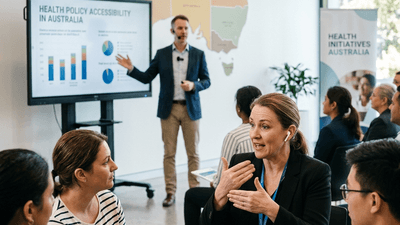



In an increasingly complex administrative and public health landscape, the cost of miscommunication in Australia is no longer just passing confusion—it is a matter of public safety, social exclusion, and economic stagnation. For Australia’s language professionals, the mandate has never been clearer: translation and interpreting are not merely logistical add-ons, but the fundamental infrastructure of an equitable society. Emerging data from public health sectors, accessibility advocates, and international education policy underscore a growing demand for nuanced, professional language services across the nation.
Public Health on the Line: The CALD Vaccination Gap
The intersection of public health and language access has always been critical, but recent trends reveal a worrying regression. UNSW researchers highlight a widening gap in vaccination rates among Culturally and Linguistically Diverse (CALD) communities across Australia. The core issue is not a lack of willingness to participate in public health initiatives, but rather a profound deficit in accessible, culturally nuanced information.
According to the UNSW findings, the reliance on ad-hoc bilingual staff, family members, or automated translation tools has proven insufficient in conveying the complex, often evolving information surrounding immunisation. The research underscores an urgent need for professional interpreters and high-quality, native-language materials to rebuild trust and comprehension.
"When health literacy is compromised by language barriers, the entire public health framework is weakened. Professional interpreters do more than translate words; they navigate cultural nuances and build the trust necessary for medical compliance."
Implications for Medical Interpreters
For practitioners in the healthcare space, this widening gap presents both a challenge and an advocacy opportunity:
- Demand for Specialisation: There is an increasing need for interpreters with specialized medical training who can accurately convey immunological concepts without causing alarm or confusion.
- Shift from Reactive to Proactive: Language service providers (LSPs) must advocate for proactive translation of public health campaigns, rather than treating interpreting as a reactive measure at the clinic door.
- Cultural Brokering: Interpreters are increasingly recognized as cultural brokers. Understanding the specific health beliefs of a target demographic is just as vital as linguistic fluency.
Beyond the Spoken Word: Elevating Auslan Accessibility
While spoken-language interpreters tackle the CALD healthcare gap, a parallel movement is reshaping accessibility for Australia's Deaf community. The traditional view of interpreting often centers on live, real-time interactions. However, as Deaf Connect highlights the vital work of Deaf Translators, the industry is witnessing a surge in demand for asynchronous translation of media and workplace documents into Australian Sign Language (Auslan).
This evolution from live interpreting to recorded translation is a game-changer for workplace inclusion. Deaf Translators are actively converting complex written English—ranging from HR policies and safety manuals to corporate media—into native, accessible Auslan video content.
The Rise of the Deaf Translator
This specialized role diverges significantly from traditional interpreting. It requires deep analytical skills to deconstruct written English and reconstruct it visually and spatially in Auslan. The practical takeaways for the sector include:
- Expanding Service Portfolios: LSPs should integrate Auslan video translation into their standard corporate accessibility packages, moving beyond just providing interpreters for live meetings.
- Quality Assurance: Translating written text to Auslan requires rigorous QA processes, often involving peer review by native Deaf professionals to ensure spatial grammar and cultural appropriateness are maintained.
- Technological Integration: The creation of Auslan resources relies heavily on video production technology, requiring language professionals in this space to develop multimedia competencies.
Untangling Policy: The 'Alphabetti Spaghetti' of International Education
The necessity for clear communication extends far beyond health and physical accessibility; it is also threatening one of Australia's largest export industries: international education. A recent analysis by The PIE News explores how Australia’s convoluted international education policies are creating massive barriers for prospective students.
The sector is drowning in an "alphabetti spaghetti" of acronyms—most notably ELICOS (English Language Intensive Courses for Overseas Students). For non-native English speakers attempting to navigate visa requirements, course structures, and compliance policies, this bureaucratic jargon is exclusionary. It is a stark reminder that English itself can be a foreign language when cloaked in bureaucratic acronyms, even to those who possess working fluency.
Plain English as a Translation Discipline
For translators working in the education and government sectors, the ELICOS confusion highlights a critical professional pivot. Translating a confusing English policy directly into another language often just results in confusing foreign-language policy. Instead, translators must increasingly act as plain-language editors.
Cross-Sector Synthesis: The Demand for Comprehension
To understand the full scope of how these distinct challenges interact, we can map the current demands placed on Australia's language professionals across these three critical sectors:
| Sector | The Barrier | The Language Solution | Professional Opportunity |
|---|---|---|---|
| Public Health | Slipping CALD vaccination rates due to complex medical information. | NAATI-certified medical interpreters and localized, culturally adapted health materials. | Specialization in medical terminology and cultural health brokering. |
| Corporate / Workplace | Inaccessible written HR and safety documents for the Deaf community. | Deaf Translators converting written English into permanent Auslan video resources. | Expansion into multimedia translation and asynchronous Auslan content creation. |
| International Education | Confusing policy acronyms (e.g., ELICOS) alienating prospective students. | Plain-language editing combined with high-quality, localized educational translation. | Consulting on policy communication and plain-language institutional drafting. |
Looking Ahead: The Future of Australian Language Services
As we navigate the middle of 2026, the throughline connecting UNSW’s health data, Deaf Connect’s accessibility initiatives, and the international education sector's policy struggles is undeniable. Australia's systems are growing more complex, and the populations engaging with them are growing more diverse.
For translators, interpreters, and language service providers, this is a moment of profound professional validation. The market is demonstrating that automated tools and ad-hoc bilingualism cannot bridge the nuanced gaps of healthcare compliance, cultural accessibility, and policy comprehension. By investing in specialized training—whether in medical interpreting, Auslan media production, or plain-language policy translation—Australia’s language professionals can position themselves not just as service providers, but as indispensable partners in the nation’s social and economic infrastructure.