
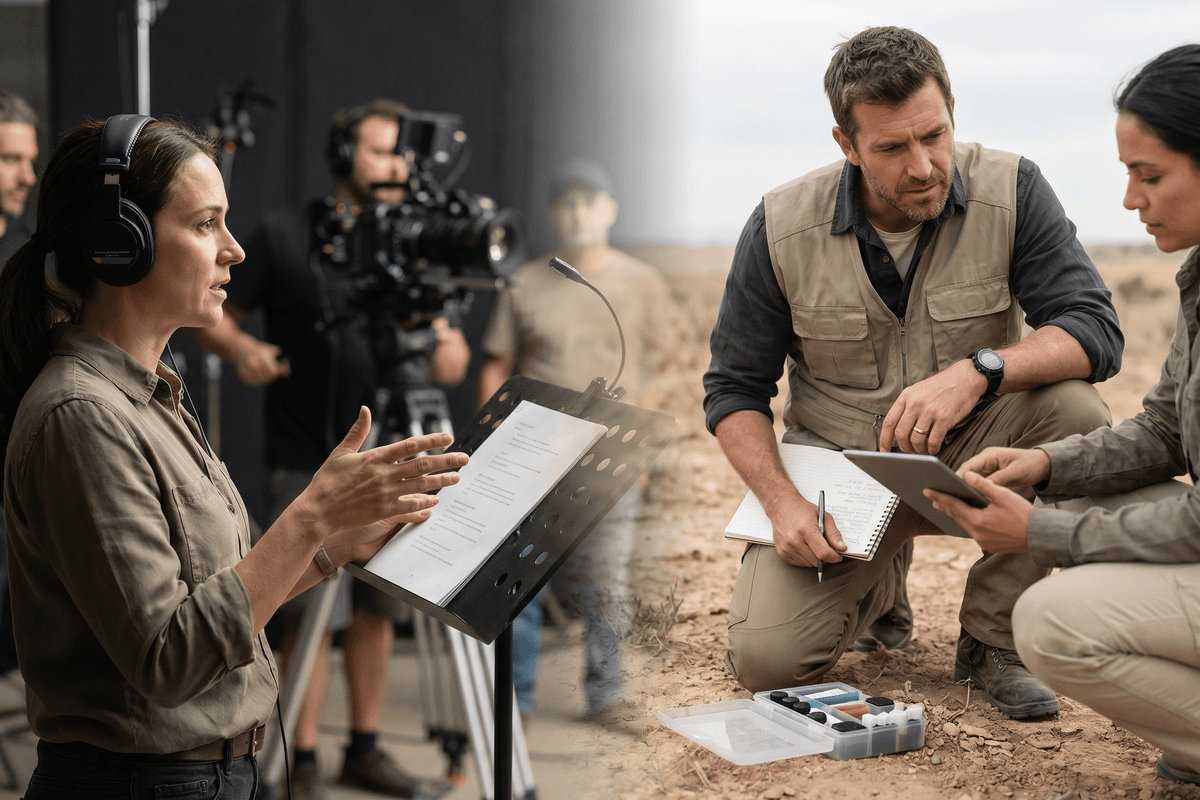



For decades, the archetype of the Australian language professional was firmly rooted in the community sector—facilitating conversations in hospital wards, courtrooms, and government offices. While these foundational pillars remain critical, a quiet evolution is taking place. Today’s translators and interpreters are increasingly being called upon to navigate hyper-specialized, non-traditional environments. Two emerging frontiers perfectly illustrate this shift: the dynamic, high-stakes world of Australian film and television production, and the complex, technical realm of environmental research.
As the industry expands, practitioners are discovering that fluency and cultural competency are merely the baseline. Success in these new arenas requires deep domain-specific knowledge, specialized glossaries, and an adaptability that pushes the boundaries of traditional language services.
Action! The Push for Auslan on Australian Film Sets
The Australian screen industry is undergoing a long-overdue transformation regarding accessibility and authentic representation. As more Deaf actors and filmmakers step in front of and behind the camera, the logistical realities of film production are highlighting a highly specific skills gap: the need for interpreters who understand the unique rhythm and jargon of a working set.
Recently, Sign on Screen, in collaboration with advocate and creative Nathan Borg, launched a targeted initiative seeking experienced Auslan interpreters who have previously worked on Australian film and TV sets. Their goal is to create a dedicated, centralized resource for Deaf filmmakers and actors—a roster of professionals who don't just know Auslan, but who know the industry.
The Unique Anatomy of Set Interpreting
Working on a film set is unlike any other interpreting assignment. It is an environment governed by strict hierarchies, rapid-fire technical jargon, and precise spatial requirements.
- Spatial Awareness and Sightlines: Interpreters must maintain clear sightlines with Deaf talent or crew without crossing into the camera's frame, casting unwanted shadows, or tripping over complex cabling.
- Industry Jargon: From "striking" (turning on a bright light) and "martini shot" (the last shot of the day) to "crossing" (moving through the frame), the vocabulary is highly specific. An interpreter must convey these technical cues instantly to ensure safety and efficiency.
- Translating Artistic Intent: When a director gives notes to a Deaf actor, the interpreter is not just translating words; they are conveying emotional nuance, pacing, and artistic direction—often in a high-pressure, time-sensitive environment.
"The creation of a dedicated resource for Film and TV Auslan interpreters is more than an administrative convenience; it is a vital piece of industry infrastructure that empowers Deaf creatives to work seamlessly and safely on Australian sets."
For Auslan interpreters looking to break into this niche, the message is clear: upskilling in screen production protocols is just as important as linguistic maintenance. The initiative by Sign on Screen represents a significant step toward formalizing this specialization, potentially paving the way for targeted micro-credentials in the future.
The Environmental Imperative: Translating the Climate Crisis
While Auslan interpreters are navigating the physical complexities of film sets, Australian translators are tackling a different kind of frontier: the urgent and highly technical world of environmental science. As climate change impacts diverse populations across the country, the need to communicate scientific research to multicultural communities has never been more pressing.
A recent report highlighted by Biomass Thermal underscores how environmental research is reaching wider communities through reliable NAATI translation solutions. Scientific discoveries, sustainability guidelines, and climate action plans are no longer being confined to English-speaking academic circles; they are being actively localized to ensure equitable access to vital environmental data.
The Challenge of Eco-Linguistics
Translating environmental research presents a unique set of challenges that test the limits of a translator's technical vocabulary and conceptual adaptability.
- Conceptual Equivalence: Many modern environmental terms—such as "carbon sequestration," "biomass thermal conversion," or "circular economy"—do not have direct, universally agreed-upon equivalents in emerging community languages. Translators must act as science communicators, finding ways to explain complex mechanisms accurately without diluting the science or confusing the reader.
- High Stakes and Policy Impact: Environmental translations often inform community behavior, from local recycling protocols to disaster preparedness in the face of extreme weather events. The accuracy of these NAATI-certified translations can directly impact public safety and ecological outcomes.
- Continuous Glossary Updating: The language of climate science evolves rapidly. Translators specializing in this field must engage in continuous professional development (CPD) to stay abreast of the latest scientific terminology and global environmental policies.
Comparing the Frontiers: Screen vs. Science
Though they seem worlds apart, the film set and the environmental research lab share a common thread for language professionals: they both demand a departure from generic practice and a deep dive into hyper-specialization.
| Specialization | Language Mode | Core Challenges | Key Competencies Required |
|---|---|---|---|
| Film & Television Production | Auslan Interpreting (Live) | Set etiquette, rapid jargon, spatial awareness, dynamic lighting | Industry terminology, physical stamina, adaptability, understanding of production hierarchy |
| Environmental Science | Document Translation (Written) | Technical scientific jargon, conceptual equivalence, audience adaptation | Subject matter expertise, advanced research skills, precision, cultural nuance in science communication |
Practical Implications for Australian Language Professionals
For practitioners looking to future-proof their careers, the rise of these niche sectors offers a clear roadmap. Relying solely on generalist community work is becoming a thing of the past. To capitalize on these emerging frontiers, professionals should consider the following steps:
- Invest in Niche Networking: If you want to interpret on film sets, attend screen industry networking events, join local filmmaking groups, and connect with organizations like Sign on Screen. If environmental translation is your goal, engage with local scientific bodies, sustainability NGOs, and university research departments.
- Build Collaborative Glossaries: The terminology in both of these fields is highly specific. Collaborate with peers to build and share open-source glossaries for technical jargon, whether it's the Auslan sign for "boom mic" or the Arabic translation for "biodiversity loss."
- Advocate for Specialized CPD: As these fields grow, there will be a need for formal training. Practitioners should advocate through bodies like AUSIT and ASLIA for targeted professional development workshops that cover non-traditional domains.
The Australian language profession is outgrowing its traditional borders. From the bustling, floodlit stages of film sets to the quiet, data-driven corners of environmental research labs, translators and interpreters are proving that language access is a universal necessity. As organizations like Sign on Screen build targeted resources and scientific bodies increasingly rely on NAATI professionals to democratize data, the message to the industry is clear: the most exciting opportunities lie in mastering the niches.