
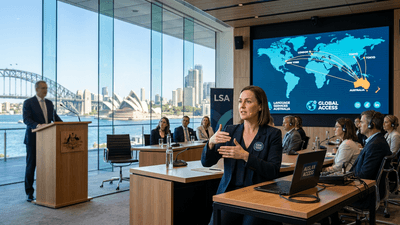



For decades, Australia’s language services sector has focused primarily on meeting the complex needs of our distinctly multicultural domestic population. But a subtle, powerful shift is underway: Australia is no longer just managing its own linguistic diversity; it is actively exporting its gold-standard professional frameworks to the world, while simultaneously pioneering rapid-access technologies at home. As artificial intelligence disrupts traditional translation models and domestic accessibility demands reach new heights, the Australian language professional is emerging as a global benchmark.
Two recent developments perfectly encapsulate this dual momentum. In Southeast Asia, Australian ethical frameworks are being utilized to future-proof the translation industry against AI disruption. Simultaneously, on home soil, a groundbreaking government initiative is redefining how Deaf and hard-of-hearing Australians access essential services.
The Global Export of Australian Ethical Standards
As machine translation and generative AI tools become ubiquitous, the value proposition of the human translator is shifting fundamentally from mere linguistic conversion to ethical stewardship, cultural nuance, and accountability. This shift has prompted international bodies to seek out the world's most robust regulatory frameworks.
Recently, the Malaysian Translators Association (Persatuan Penterjemah Malaysia, or PPM) recognized the urgent need to fortify its professional standards in the AI era. As Bernama reports, PPM has launched a comprehensive Code of Ethics course designed to uphold the integrity of the profession as demand grows and technological disruption accelerates. Crucially, to deliver this pivotal training, PPM enlisted a translator and interpreter accredited by Australia’s National Accreditation Authority for Translators and Interpreters (NAATI).
Why NAATI Accreditation Resonates Globally
The decision to utilize a NAATI-accredited professional for international ethics training is not coincidental. It highlights a growing international consensus that Australia’s regulatory environment for language professionals is world-leading. But what exactly makes the Australian framework so exportable?
- Rigorous Testing of Ethical Dilemmas: Unlike certifications that focus solely on linguistic fluency, NAATI’s credentialing places equal weight on navigating complex, real-world ethical dilemmas—skills that AI cannot replicate.
- Continuous Professional Development (CPD): The Australian model mandates ongoing education, ensuring practitioners remain agile in the face of evolving technologies.
- Institutional Accountability: Australia’s interconnected network of professional bodies (like AUSIT) and credentialing authorities creates a culture of accountability that developing language markets seek to emulate.
"The AI era does not replace the translator; it elevates them to the role of an ethical arbiter. Malaysia's decision to look to a NAATI-accredited practitioner demonstrates that Australia's investment in rigorous professional standards is yielding international dividends."
Domestic Innovation: Revolutionizing Auslan Accessibility
While Australian ethical standards are making waves abroad, domestic service delivery is undergoing its own high-tech revolution. We have previously covered the critical "1-to-100" shortage of Auslan interpreters in Australia, a crisis that has historically left Deaf Australians facing long wait times for essential appointments.
In a major leap forward, Services Australia has announced a transformative new initiative: free, on-demand Auslan sign language interpreters via video chat across their service centres. This Video Remote Interpreting (VRI) service is designed to connect individuals to a qualified interpreter within 30 minutes, entirely removing the need for pre-booked appointments.
Breaking the Bottleneck with VRI
The introduction of on-demand VRI by a major federal agency represents a paradigm shift in how language services are deployed in Australia. It directly addresses the logistical friction that has historically exacerbated interpreter shortages.
| Service Delivery Model | Traditional Pre-Booked Model | New On-Demand VRI Model |
|---|---|---|
| Wait Times | Often days or weeks in advance | Within 30 minutes |
| Interpreter Efficiency | High downtime due to travel between sites | Zero travel time; maximized interpreting hours |
| Client Autonomy | Requires significant forward planning | Allows for spontaneous, immediate service access |
| Geographic Reach | Limited to metro or regional hubs with local talent | Universal access regardless of the client's physical location |
By eliminating travel time, Services Australia is effectively increasing the functional capacity of the existing Auslan interpreter workforce. An interpreter sitting in a remote home office can now service a client in rural Queensland at 10:00 AM and another in metropolitan Melbourne at 10:45 AM. This high-efficiency model is essential for managing the growing demand for accessibility in a resource-constrained sector.
Practical Implications for Australian Language Professionals
The convergence of these two developments—international demand for Australian ethical frameworks and the domestic integration of rapid VRI technology—paints a clear picture of the future for language professionals in this country. To thrive in this evolving landscape, practitioners must adapt to new modes of working.
- Lean Into Ethical Consultancy: As AI commoditizes basic translation, the premium will be on human judgment. Translators should market themselves not just as bilingual typists, but as cultural and ethical consultants who guarantee confidentiality and localized nuance. Highlighting NAATI credentials on international platforms like LinkedIn or global translation portals is highly recommended.
- Master the Virtual Environment: The Services Australia initiative proves that VRI is no longer a stopgap measure born of the pandemic; it is a permanent fixture of public service delivery. Interpreters must ensure their remote setups are professional-grade. This means investing in high-speed, stable internet, professional lighting, neutral backgrounds, and high-fidelity audio equipment.
- Prepare for Triage Interpreting: On-demand services require a different cognitive skill set than pre-booked appointments. Interpreters must be prepared to drop into a context with minimal briefing and rapidly establish rapport and situational awareness. Continuous professional development in active listening and rapid context-switching will be vital.
Looking Ahead: High-Tech Delivery, High-Touch Ethics
The Australian language services sector is standing at a fascinating intersection. We are leveraging technology—from VRI to integrated service platforms—to break down historical barriers to access, as seen in the remarkable Services Australia Auslan rollout. Yet, we are simultaneously doubling down on the deeply human elements of our profession, exporting our rigorous ethical standards to nations seeking guidance in an increasingly automated world.
For the Australian translator or interpreter, the message is clear: the future belongs to those who can seamlessly blend technological fluency with unshakeable ethical integrity. By embracing both, Australia is not just keeping pace with the global language industry—we are charting its course.